The Real Cost of Klay's ACL: NBA Case Study
One torn ligament, four line items, and a bill somewhere north of $470 million.
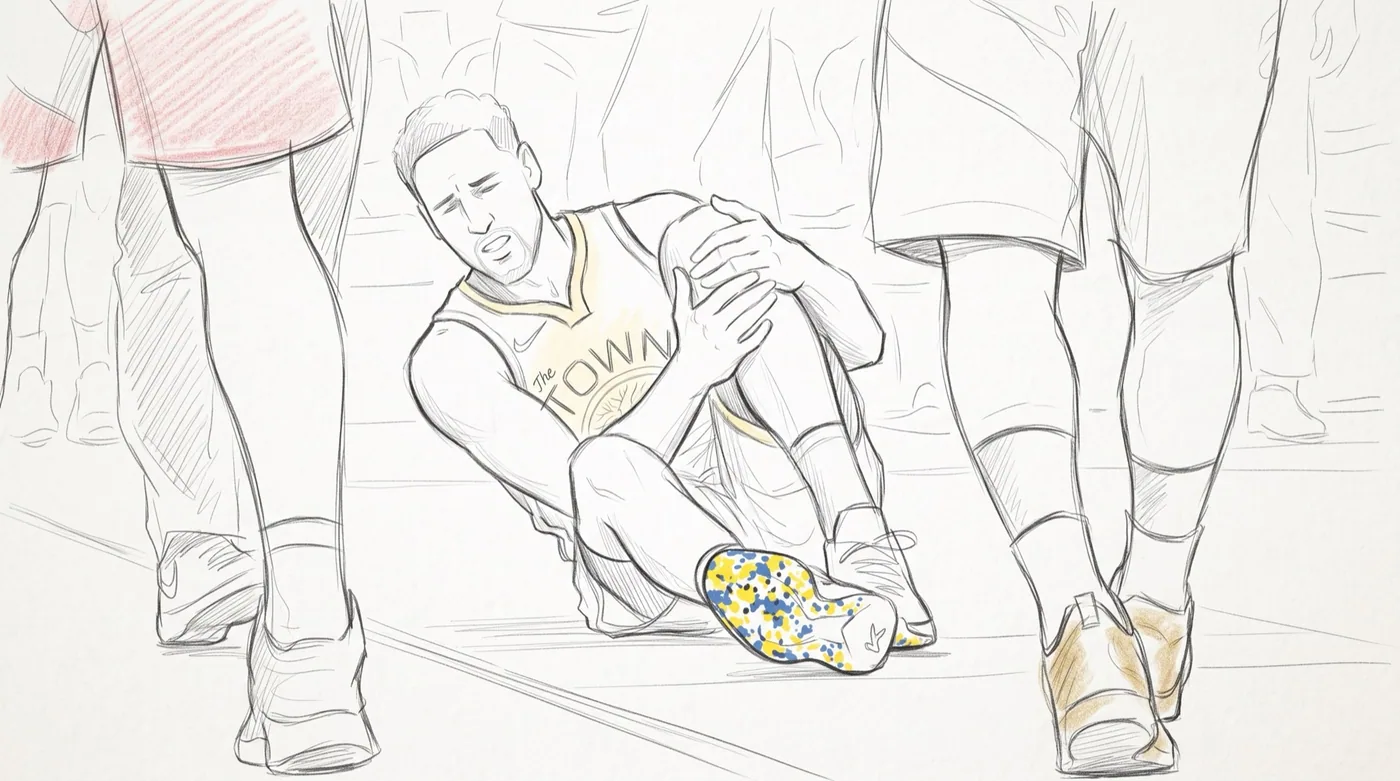
Two nights in June 2019 ended a dynasty.
The Golden State Warriors went into the 2019 Finals as heavy favorites at −310 against a Toronto Raptors team sitting at +250, and they were favored without Kevin Durant, who had missed nine straight games with a calf strain. Durant came back for Game 5, lasted until the second quarter, and ruptured his Achilles. Two days later, in Game 6, Klay Thompson tore his ACL driving to the basket.
Toronto won its first championship. Durant signed a four-year, $194 million deal with Brooklyn. Thompson re-signed with Golden State for five years and $190 million, and then did not play a single NBA game for two and a half years.
That last sentence is the one worth pricing out. Not "what did the Warriors lose by losing the series" — what did the organization actually pay, in dollars, for one torn ligament?
The answer is larger than almost anyone guesses, and only about a fifth of it is salary.
Why ACL tears are the expensive ones
Player availability is the single largest determinant of an NBA team's competitive and financial outcomes, and teams already spend enormously to protect it — medical staff, prevention programs, rehabilitation facilities. An ACL tear defeats all of it. It typically costs a full season, sometimes more, and it arrives with genuine uncertainty about what the player looks like on the other side.
When it happens to a role player, a team absorbs it. When it happens to a franchise cornerstone, the cost stops being a salary line and starts moving through everything else the organization sells.
Line item one: the salary — $100 million
The Warriors paid Klay Thompson roughly $85 million before he played another NBA game. He tore the ACL in June 2019, missed all of 2019-20, then ruptured his Achilles in November 2020 and missed all of 2020-21 as well. He returned in January 2022, having missed close to 1,000 days of basketball.
He then missed another 30 games across the remainder of that contract, logged variously as rest, injury management, and knee — call it another $15 million in games paid for and not played.
That figure is the part people forget. Before the tear, Thompson was an iron man: six missed games from lower-body injury in his first 626. He was, by availability, one of the safest large contracts in basketball. Right up until he wasn't.
Worth flagging: in the months before the ACL tear he had started missing time with knee issues — a pattern that shows a strong correlation with subsequent ACL tears.
Line item two: the luxury tax — $130 million
Here is where an NBA injury stops behaving like an ordinary payroll problem.
The Warriors were not merely over the salary cap. They were repeat offenders, deep into the highest brackets, where the league charges a penalty on every additional dollar of payroll:
| Amount over the tax threshold | Tax per excess dollar | Repeat-offender rate |
|---|---|---|
| $4,999,999 or less | $1.50 | $2.50 |
| $5m – $9,999,999 | $1.75 | $2.75 |
| $10m – $14,999,999 | $2.50 | $3.50 |
| $15m – $19,999,999 | $3.25 | $4.25 |
| Over $20 million | $3.75 + $0.50 per $5m | $4.75 + $0.50 per $5m |
Read the bottom row again. Past $20 million over the threshold, a repeat offender pays $4.75 in tax for every $1 of salary. Thompson's contract sat squarely in that territory.
Across the two seasons he missed entirely, Golden State paid roughly $250 million in luxury tax. The following year, with Thompson out for the first half, another $163 million. Attributing that to any one contract is genuinely hard — the roster was full of expensive players — and the defensible range for Thompson's share runs from $130 million to $200 million.
I'll use the bottom of that range for the total. It is the number I can defend without argument.
Line item three: the replacement — $17 million
A team this far over the cap cannot go shopping. The only tool available was the minimum contract, about $1.5 million a year at the time.
Except nothing costs $1.5 million when you are $20 million over the threshold. At $3.75 of tax per dollar, a minimum-salary body cost the Warriors approximately $7 million a season — for a player brought in specifically because they could not replace what they had lost.
Over the stretch Thompson missed, that's roughly $17 million spent on not replacing him.
What it looked like on the floor
In 2016 the Warriors went 73-9 — an 89% win rate, the best regular season in league history. During Thompson's absence they won 23% of their games in 2020 and 54% in 2021. He came back, they won 65%, and they took the 2022 title.
Strictly, team performance is not a cost. Nobody invoices you for losing. But it is the mechanism through which the next line item happens, and the next line item is the biggest one.
Line item four: the ticket revenue — $224 million
Golden State's ticket prices had spent the 2010s pulling away from the rest of the league, and in 2019 the team opened Chase Center — more than 18,000 seats, 41 home dates a season.
Then the prices went the other way.
The red dashed line is the projection: where Warriors ticket prices would have gone had they followed their own prior trend, adjusted for what the NBA as a whole experienced. The gap between the dashed line and the blue one is the part that belongs to the injury.
Some of that drop is obviously COVID — the whole league fell in 2020-21. But the Warriors fell considerably further than the league did, and the two things research says drive ticket prices, once you control for market size, are team performance and star attraction. Thompson's injury took a bite out of both at the same time.
Estimated regular-season ticket revenue lost across the seasons he missed: approximately $224 million. Golden State missed the playoffs in both 2020 and 2021, so there is no postseason gate in that figure at all.
Food, beverage, and merchandise almost certainly moved with attendance. None of it is documented well enough to put a number on, so none of it is counted here.
Did he come back?
The honest answer is: more than anyone expected, and not all the way.
LEBRON — Luck-adjusted player Estimate using a Box prior Regularized ON-off — is BBall Index's impact metric, combining box score production with regularized on/off data into a single per-100-possessions number. By that measure Thompson returned to roughly his pre-injury contribution level in 2022. For an athlete coming off an ACL tear and an Achilles rupture, that is genuinely rare.
But the trend across the following three seasons says he is not getting back to his 2015 peak, and there is a second opinion available that does not care about anyone's metric. After the $190 million deal expired, Thompson signed with Dallas for three years and $50 million. His pay went from $43 million in 2023-24 to $16 million in 2024-25.
The market is not sentimental. It priced the difference at about 63%.
The bill
| Cost | Amount |
|---|---|
| Salary paid while unavailable | $100 million |
| Luxury tax on that salary (lower bound) | $130 million |
| Replacement players, tax included | $17 million |
| Lost regular-season ticket revenue | $224 million |
| Total | $471 million |
Call it $470 million and up, because several real costs are missing from it: surgeries and rehabilitation hires (likely insured, and not public), food and beverage, merchandise, the entire 2020 and 2021 postseasons that never happened, and whatever value there was in a dynasty that got to keep going.
The salary — the number everyone quotes when a star goes down — is 21% of the total.
Why this is worth pricing
An organization deciding how much to spend on prevention, load management, biomechanics, and rehabilitation is implicitly making a bet about what an injury costs. If the working number in that bet is "his salary," the bet is being made against a figure that is off by a factor of five.
One ligament, in one knee, on one night in June, cost a team most of half a billion dollars.
Spending real money to make that less likely is not a luxury. It is the cheapest line item in this entire post.